Demand hotspots
Identify zone-level hotspots
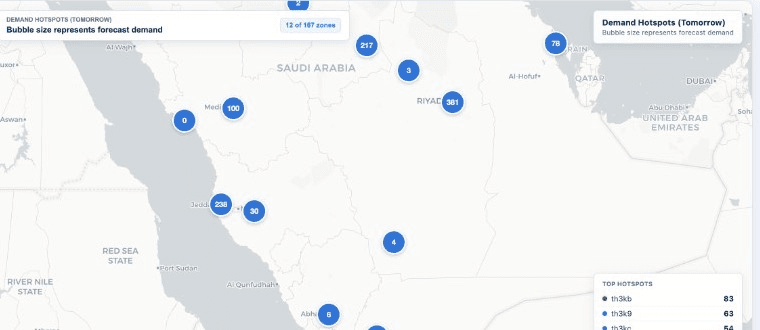
See where tomorrow’s demand will concentrate — and which zones need proactive attention.

AI Operations Planning™
Logibee's AI Operations Planning capability turns demand uncertainty into actionable operational decisions across zones, drivers, and logistics models.
Planning Intelligence Graph · Demand → Forecast → Capacity → Action
Planning workspace preview
Explore in context: Retail & Commerce · AI Planning Intelligence · Platform · Related Solutions · Book Discovery Call
For enterprise evaluation: Platform · Retail & Commerce · Proven deployments · Enterprise integration
Relevant for operations directors, logistics leaders, and technology teams evaluating capability fit.
Logibee Knowledge Platform
Explore solution-aligned knowledge — executive frameworks, COO playbooks, and logistics problems connected to this capability.
The Problem
The Shift
Traditional Operations
Modern Operations
The Solution
A unified planning intelligence system that understands demand patterns, forecasts zone-level demand, calculates required driver capacity, identifies imbalances, recommends actions, and simulates future scenarios — so teams know what to do next.
Planning workspace
See tomorrow's demand before the day begins. Forecast demand by city, zone, and shift window, then understand where drivers will be needed most.
Scenario Simulation: Test demand changes before operations start — simulate base, increased, or reduced demand to understand operational impact ahead of execution.
Operational Briefing
Logibee converts demand predictions into priority actions, capacity requirements, and driver rebalancing plans — so teams act before execution begins.
Demand hotspots
See where tomorrow’s demand will concentrate — and which zones need proactive attention.
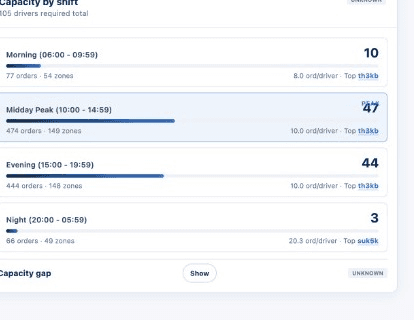
Capacity planning
Translate demand into required drivers per shift and surface gaps before execution begins.
Rebalancing plan
Move from forecast to action with driver rebalancing moves and priority guidance.

Core Capabilities
Logistics Models
Warehouse to customer flows with distributed demand and zone-level planning.
Central dispatch to delivery zones with clustered demand and driver capacity planning.
Hybrid logistics models with multiple demand patterns and adaptive recommendations.
Forecast Explainability
Planning teams can review demand history, model confidence, baseline logic, key drivers, and anomalies before acting — building trust and decision speed.
Forecast readiness
Review confidence signals and evaluation diagnostics before committing capacity changes.

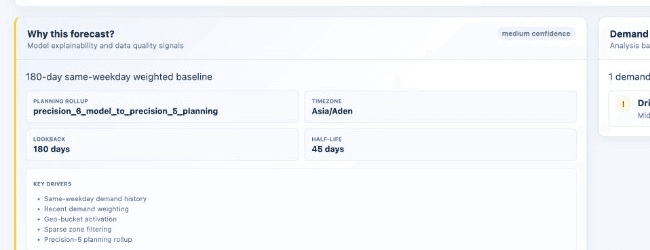
Why this forecast?
See baseline logic, lookback, half-life, key drivers, and warnings behind the prediction.
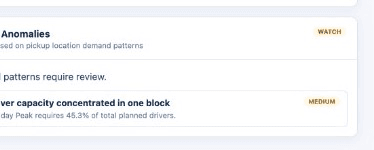
Demand anomalies
Surface anomalies early so teams can correct assumptions before execution pressure begins.
Planning Intelligence View
Product visuals can replace this placeholder when screenshots are available.
Preview
Forecasted demand
Preview
Required capacity
Preview
Recommended actions
Preview
Scenario-based insights
Preview
Operational narrative
Business Impact
Reduce idle drivers, improve route readiness, and optimize resource allocation across zones.
25% improvement in resource utilization
Lower operational overhead, reduce last-minute decisions, and minimize planning inefficiencies.
20% reduction in operational cost
Move planning from hours to minutes with less spreadsheet dependency and more operational confidence.
90% faster planning decisions
Why Logibee
Most tools show
What happened.
Logibee shows
What to do next.
AI Operations Planning strengthens Logibee's position as an AI-Powered Logistics Operations Orchestration Platform — not a delivery management system, route optimization tool, or tracking platform.
AI Operations Planning
Discuss how AI Operations Planning can help your team forecast demand, plan capacity, and act before execution begins.
Enterprise FAQ